Rabbit Holes a commonplace book,kept in the open
Subject · 15 folios

Economics

Markets, development, money, inequality, and incentives in the wild.

364 Link 30 Jun 2026

Is microfinance useful or useless?

The evidence base for microfinance being effective was always extremely thin. Morduch (1999), in an otherwise hopeful article on the development of microfinance, could not help but note the paucity of the available evidence that it was actually doing anything. The best evidence cited at the time for the Grameen Bank was Pitt and Khandker (1998), who used an eligibility requirement to infer the effect of the loans. However,…

keep reading — 2 min ↗
MicrofinanceEconomicsPoverty 4 threads →
260 Link 21 Feb 2026

Trump's stupid trade war takes a stupid new turn

source · nytimes.com ↗

The court’s 6-3 decision has significant implications for the U.S. economy, consumers and the president’s trade policy. The Trump administration had said that a loss at the Supreme Court could force the government to unwind trade deals with other countries and potentially pay hefty refunds to importers. Mr. Trump is the first president to claim that a 1970s emergency statute, which does not mention the word “tariffs,” allowed…

keep reading — 3 min ↗
TariffsTrumpEconomy 4 threads →
228 Link 04 Feb 2026

Age of anxiety

source · economist.com ↗

THERE is still time for the cheerful and the gloomy to disagree, sincerely, about the net impact on employment from automation and artificial intelligence. Perhaps AI will unleash a job-creating economic boom for the ages, as boosters maintain. Maybe on balance the doom-mongers are right, and grim legions of algorithm-guided bots and robots will conquer one industry (and profession) after another. One outcome is not up for…

keep reading — 1 min ↗
EconomyWorkAI 4 threads →
218 Link 31 Jan 2026

Some interesting facts

source · benthams.substack.com ↗

Lots of population numbers are pretty made-up. In many countries, there just isn’t really the infrastructure to do a good census. In Papua New Guinea, they’re not sure if the number of people is 9 million or 17 million. Similar things are true in other countries like Nigeria, which may have tens of millions more or fewer people than is standardly reported. In lots of countries, the way they get their official census numbers…

keep reading — 2 min ↗
ConsciousnessEconomicsBiology 4 threads →
203 Link 26 Jan 2026

Fuck you money

source · jlcollinsnh.com ↗

There are many things money can buy, but the most valuable of all is freedom. Freedom to do what you want and work for whom you respect. Those who live paycheck to paycheck are slaves. Those who carry debt are slaves with even stouter shackles. Don’t think for the moment their masters don’t know it. Chains I first accumulated the modest amount I needed around 1989. Not enough to retire on perhaps, but enough to say F-you if…

keep reading — 2 min ↗
MoneyFreedom 4 threads →
182 Link 16 Jan 2026

The future of AI and automation

Summary by Claude. Let me break down what Jones and Tonetti are arguing. The Core Question How much of past economic growth came from automation, and what does that tell us about AI's future impact? The Key Insight: "Weak Links" The paper's central concept is that economic production involves complementary tasks — you need all of them to produce output. Think of it like a chain: your output is limited by your weakest link,…

keep reading — 3 min ↗
AIAutomationEconomic growth 4 threads →
118 Musing 13 Dec 2025

Poor countries are not catching up with rich countries

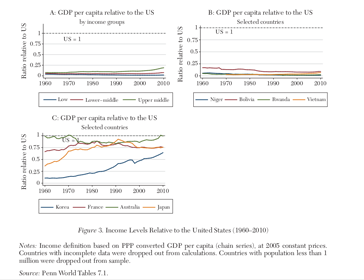
The original story of divergence then convergence remains the same, despite the scope for the revised data to alter results. For the three decades leading up to the empirical literature on economic growth, the gap between developed and developing nations expanded. That all started to change around the fall of the Berlin wall, and poor countries went from lagging behind richer ones to maintaining pace with and then ultimately…

keep reading — 5 min ↗
Economic development 4 threads →
106 Musing 21 Nov 2025

The future of global trade

Both economists agree that growth is still possible, but the age of “hyperglobalisation” – with its extraordinary convergence of openness, technology, and trust – is unlikely to return. > “Growth miracles seem less likely because two of the key mechanisms – access to big, lucrative markets and willingness to share technology across borders – no longer seem to be here.” Goldberg As global trade enters a new, more fragmented…

keep reading — 1 min ↗
TradeEconomic development 4 threads →
073 Musing 20 Oct 2025

Naked without values

This deterioration in the practice of politics can be attributed to many causes. One of the most important may be found in the deterioration in how economics is practiced. Economics is often described as a scientific discipline, which studies “if-then” propositions without reference to morals and values. But scientific findings do affect our values and normative judgments, and claims of “scientific objectivity” can be used to…

keep reading — 3 min ↗
EconomicsEqualityInequality 4 threads →
027 Link 01 Sept 2025

Will the poor countries catch up the rich?

What Remains of Cross-Country Convergence? A Critical Review of 50 Years of Economic Growth Research. Summary by Claude. This comprehensive 2020 review by Paul Johnson and Chris Papageorgiou examines one of economics' most enduring questions: Do poor countries eventually catch up to rich ones? After analyzing five decades of research and data, their conclusions challenge popular narratives about global economic convergence.…

keep reading — 5 min ↗
DevelopmentEconomics 4 threads →
001 Reflection 01 Aug 2025

The Protection Racket: A History of Tariffs and Who Really Pays

On that day, an executive order was signed imposing a sweeping new regime of "reciprocal" tariffs. The action was vast in its scope, targeting nearly 70 countries and territories in addition to the European Union. The tariff rates varied widely, based on justifications ranging from trade imbalances to national security concerns. Rates for some nations were set as high as 41% (Syria) and 39% (Switzerland), while key trading…

keep reading — 27 min ↗
TariffsTrumpTrade 4 threads →