379
Visualizing trade flows and tariffs
source · portolan.cc ↗Cool site to visualize tariffs, sanctions, and global trade deals. https://portolan.cc/ https://x.com/i/status/2081473121953911112
keep reading — 1 min ↗A shelf organized by form. For recurring ideas, browse the subjects.
Cool site to visualize tariffs, sanctions, and global trade deals. https://portolan.cc/ https://x.com/i/status/2081473121953911112
keep reading — 1 min ↗Lots of new inequality statistics from the World Bank's PIP on Our World in Data: .png>) Inequality statistics are heavily contested and rightly so, but read the right way, they still have some use.
keep reading — 1 min ↗keep reading — 2 min ↗I’m feeling it right now. I had to set a timer for 15 minute on my computer and block all distractions to write this. If I didn’t force myself to focus I would easily get distracted by something after few minutes. Even when I’m doing things that I’ve been waiting to do it, I still feel the urge to do something else. I don’t know how and when this happened. During the last few years I was always studying, working, and doing…
keep reading — 1 min ↗The WhatsApp uncles and aunties generation that have seen the benefits of the two decades after liberalisation are content with their “settled” lives, their garba in Vietnam and their misguided belief about India’s standing going up in the world because of this government. But the reality confronting the Insta generation is that their future isn’t as rosy and the correcting and disciplining mechanism of the political system…
keep reading — 3 min ↗Governments find such protests much harder to confront because there is no obvious ideological counter-narrative. One can’t simply invoke nationalism or accuse every dissatisfied student of serving foreign interests when the grievance concerns administrative failure. The usual political vocabulary becomes ineffective. More importantly, governments are generally better equipped to deal with identifiable opponents than of…
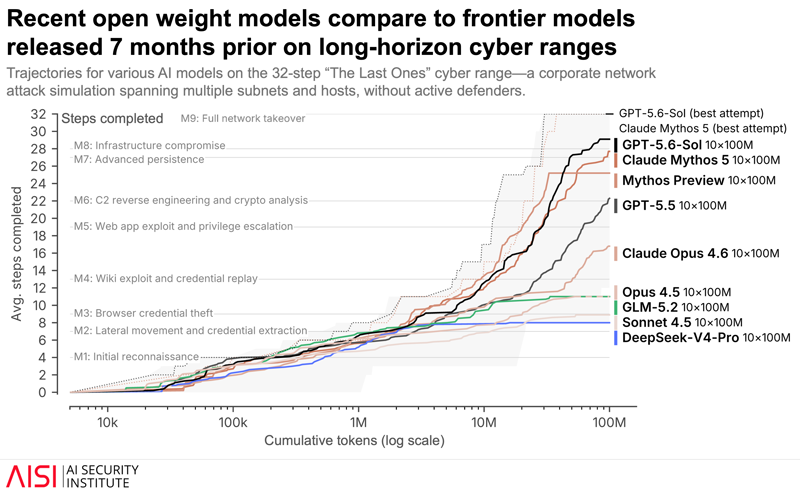
How far behind are open models in their cyber capabilities compared to closed models: --- Xiaomi is launching an open weights robotics model. ---
keep reading — 1 min ↗keep reading — 1 min ↗If debt were inherited over generations, it’s easy to see how it would quickly leave some trapped in permanent multigenerational poverty, unable to escape no matter how hard they worked or how high an income they managed to secure. The interest on debt would compound over generations and eventually no amount of work would be enough for it to be paid off. Being trapped in debt is something many can understand. But the reverse…
keep reading — 2 min ↗I want to pose a question: Is it possible that online users just have nonstop shiny object syndrome, and even if forums worked correctly and did the job, users would still move onto something else because we’re never happy? I think the argument is pretty strongly yes. That said, I do think that as the internet matures into something that is more furniture in our lives, perhaps some of us will slow down. Maybe we’ll log into a…
keep reading — 2 min ↗The evidence base for microfinance being effective was always extremely thin. Morduch (1999), in an otherwise hopeful article on the development of microfinance, could not help but note the paucity of the available evidence that it was actually doing anything. The best evidence cited at the time for the Grameen Bank was Pitt and Khandker (1998), who used an eligibility requirement to infer the effect of the loans. However,…
keep reading — 1 min ↗This article reviews recent economic studies on the causal effects of temperature on labor productivity. The negative effects of extreme temperatures are widespread, and the magnitudes of the impact differ across social and economic factors. In addition to physical outputs, extreme temperatures also impair mental productivity, including cognition and learning. In utero exposure to extreme temperatures has profound effects on…
keep reading — 1 min ↗Life is not easy for any of us. But what of that? We must have perseverance and above all confidence in ourselves. We must believe that we are gifted for something, and that this thing, at whatever cost, must be attained.
keep reading — 1 min ↗Orhan Pamuk: I understand, I am an admirer of René Girard’s work but I have come across him later in years, The Scapegoat, Sacrifice, I like these subjects, but on the other hand it was a rather simplistic or simple idea that I think that even in the worst conditions that to be able to tell a story is a sort of a great relief for me, that I believe that in fact if there are Hegelian minds who are trying to over- rule each…
keep reading — 1 min ↗Calm. Kindness. Kinship. Love. I’ve given up all chance at inner peace. I’ve made my mind a sunless space. I share my dreams with ghosts. I wake up every day to an equation I wrote 15 years ago from which there’s only one conclusion, I’m damned for what I do. My anger, my ego, my unwillingness to yield, my eagerness to fight, they’ve set me on a path from which there is no escape. I yearned to be a savior against injustice…
I use voice typing heavily because it saves me a lot of time. So I asked Claude/Codex to build me a desktop app. They built a damn good one works like a charm. Still blows my mind that a dummy like me can get this done.
keep reading — 1 min ↗keep reading — 1 min ↗3/ Try using one long-running implementer session for the entire project. Mine routinely run for days or even weeks continuously, compacting many, many times. Compaction works now. Long sessions remember your conventions and patterns and you stop needing to re-explain things. 4/ Drive it with a persistent task list. Your job is to add vetted tasks faster than it can complete them. It's like shoveling coal into a steam engine.…
keep reading — 1 min ↗Some of what we describe above is not entirely unique to Mythos Preview. When we ran other frontier models through the same harness, they found a fair number of the same underlying bugs, and in some cases they got further than we expected on the reasoning side too. Where they fell short was at the point of stitching the pieces together. A model would identify an interesting bug, write a thoughtful description of why it…
keep reading — 5 min ↗Ken Griffin: Let me share a few thoughts on this. First, over the last few months, there has been a step-change function in the productivity of the AI toolkit. It is profoundly more powerful than it was just nine months ago. At Citadel, that has allowed us to unleash a much broader array of use cases, and it has been really interesting to watch. To be blunt, work that we would usually assign to people with Master's degrees…
keep reading — 1 min ↗In a real sense all life is inter-related. All men are caught in an inescapable network of mutuality, tied in a single garment of destiny. Whatever affects one directly, affects all indirectly. I can never be what I ought to be until you are what you ought to be, and you can never be what you ought to be until I am what I ought to be... This is the inter-related structure of reality. Martin Luther King Jr.,
keep reading — 6 min ↗AI agents will continue to get smarter and more powerful. In my company, this means it no longer makes sense to hire interns or new grads as software engineers. It's easier and cheaper and faster for us to manage AI agents. That's pretty crazy! At the same time, the value of super-senior software engineers is higher than ever. Big tech pay top talent millions and millions in salary to programmers. We're still hiring, but only…
A nice analysis of long term temperature trends in India.
keep reading — 1 min ↗keep reading — 1 min ↗Maybe this sounds banal and corny, but I’ve experienced it as personally profound: you can shift your perspective from “wow, that person is being incredibly stupid” to “maybe they’re currently learning something important,” for any person, at any time. You can also do this to your view of organizations, countries, even the human species.
keep reading — 1 min ↗To hire good artists is to invest in the full potential of a story – I commissioned 171 illustrations last year – but aesthetics have economic weight. To keep a book accessible is to risk eroding margins. To price it profitably is to restrict its reach. And then there is the unease. I have woken up at 2 am and stopped the press because I dreamt I had missed a comma. In a founder-led setup, there is no buffer between editorial…
keep reading — 1 min ↗I had a client who described a lot of their problems in therapy language. I told them something like: “hey, I believe that psychotherapy was really useful for you at the time—but consider the possibility that the pathologizing language you picked up from that culture is distancing you from your experience and causing you to consider normal things problematic.” They stopped using therapy framing and found that their inner life…
keep reading — 1 min ↗One more comment from the heart: I'm old-fashioned and think that reading books is the most glorious pastime that humankind has yet devised. Homo Ludens dances, sings, produces meaningful gestures, strikes poses, dresses up, revels, and performs elaborate rituals. I don't wish to diminish the significance of these distractions—without them human life would pass in unimaginable monotony and, possibly, dispersion and defeat.…
keep reading — 1 min ↗A decent model with a great harness beats a great model with a bad harness. I’ve watched this play out on my own work over and over. And increasingly the interesting engineering isn’t in picking the model, it’s in designing the scaffolding around it.
keep reading — 1 min ↗Man has it all in his hands, and it all slips through his fingers from sheer cowardice. Fyodor Dostoyevsky, Crime and Punishment
keep reading — 1 min ↗This is the first open-weight model that plays like a top-class agentic model. Watching it go through ambiguous and meticulous chained tool work successfully puts it squarely in the wheelhouse of Opus 4.6. We're looking at an open weight model, but with much cheaper direct inference provider pricing. For a subclass of our eval set, it's outperforming GPT 5.2. We're about to undergo a gigantic industry shift.
keep reading — 2 min ↗Even commentators who spend a lot of time fretting about the modern-day ‘crisis of distraction’ rarely seem to grasp the full implications of this. For example, you hear it said that attention is a ‘finite resource’, and finite it certainly is: according to one calculation, by the psychologist Timothy Wilson, we’re capable of consciously attending to about 0.0004 per cent of the information bombarding our brains at any given…

keep reading — 13 min ↗In a sentiment he would later deepen in his moving 2013 Syracuse commencement address, he adds: > So what is stopping me from stepping outside my habitual crap? > > My mind, my limited mind. > > The story of life is the story of the same basic mind readdressing the same problems in the same already discredited ways. In a wonderful aside from another essay, he offers what may be the best recipe for breaking out of the mind’s…
keep reading — 1 min ↗The main sources of data on new recruits signing up are federal and regional budget spending reports, which include a separate section on bonuses paid for signing military contracts. The sizes of the bonuses paid at both the federal and most regional levels are a matter of record, which makes it possible to estimate the numbers of new military recruits on at least a quarterly basis. Based on these data, over the past two…
keep reading — 6 min ↗Take readers’ opinions seriously, but not too seriously. I’d say 1/6 have real spiritual-angst resistance. Ignore them. Another 1/6 will never get past attachment to gleegloom over the not-X-but-Y “tell” du jour. Ignore them too. Counterintuitively, at the other end, 1/3 of readers will be delusionally committed to declaring any and all AI writing “good” (similar to how committed feminists might insist that any work done by…
keep reading — 1 min ↗Some will argue that “this time is different” because AI is replacing knowledge work, not just physical work. And, if this comes to pass, what will there be left for people to do? It’s a compelling argument, but people made similar arguments about the automation of physical work. There was literally a group of people in England in the early 1800s called the Luddites who destroyed weaving machines due to their adverse impact…
keep reading — 1 min ↗If strong AI will lower the value of your human capital, your current wage is relatively high compared to your future wage. That is an argument for working harder now, at least if your current and pending pay can rise with greater effort (not true for all jobs).
Jensen in the Arena Om Malik on OpenAI's IPO plan Where OpenAI’s technology could show up in Iran
keep reading — 1 min ↗keep reading — 1 min ↗28 years of kottke.org, as of today. Older than Google. Older than The Matrix. Older than Christopher Nolan’s feature film career. Older than Elle Fanning. Older than Kurt Cobain when he died. 47,300 posts since March 14, 1998. It might outlast American democracy.
keep reading — 1 min ↗1\. Attention is the practice beneath all philosophical practices. Nearly every contemplative tradition—Stoic, Platonic, Christian monastic—was built on attention as the foundational practice. Practices like fasting, physical training, and meditation exist to guard the stillness attention requires. Philosophy, in this sense, is a discipline of perception, not mere argumentation. 2\. Distraction is a perennial human problem,…
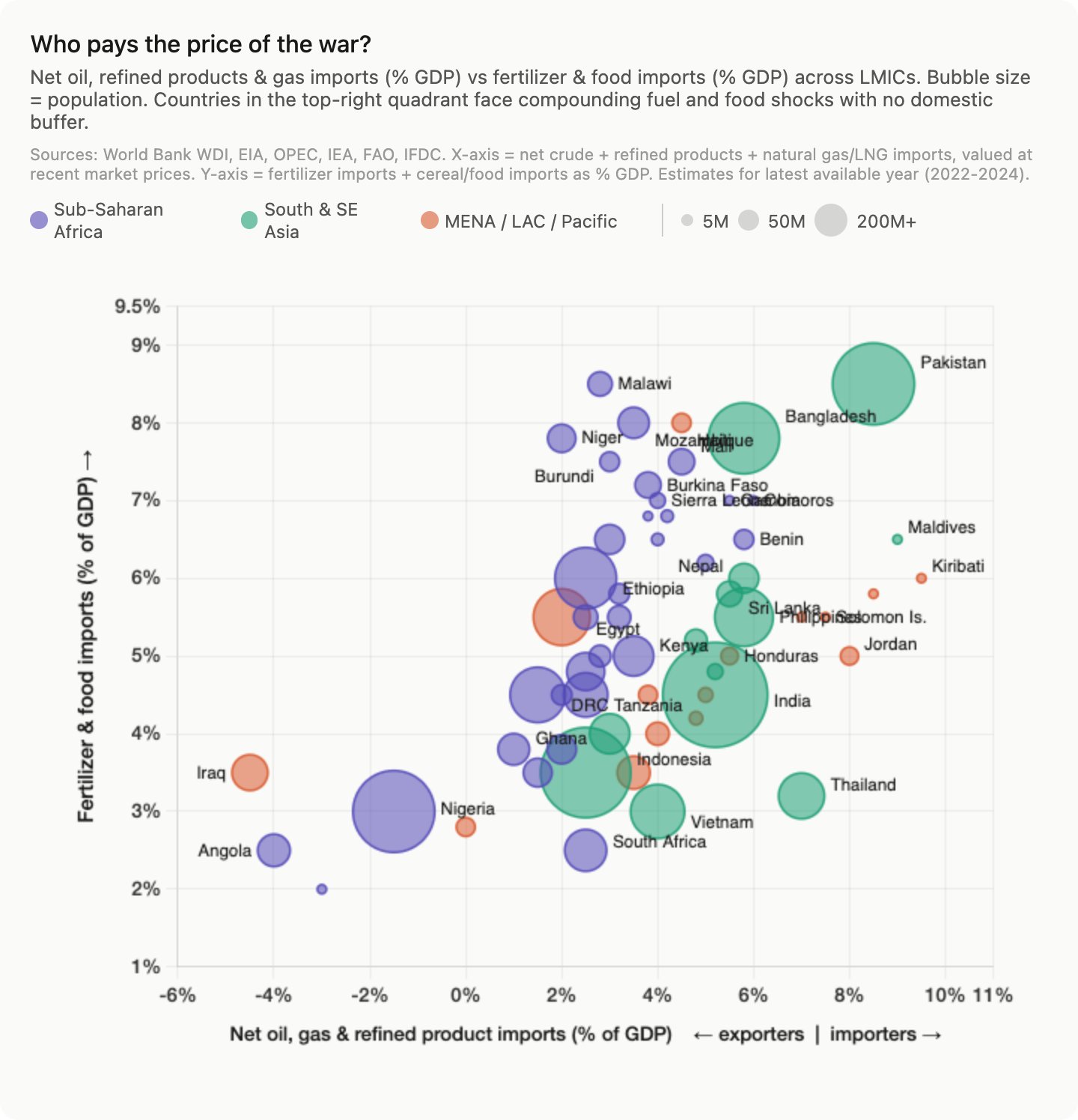
The poor countries are having to pay a disproportionate cost because of the capriciousness of the US and Israel..
keep reading — 1 min ↗Two useful webpage to markdown tools.
keep reading — 1 min ↗keep reading — 1 min ↗A writing maxim I want to tattoo on my hand: Stop trying be smart. Just be honest about how you feel.
keep reading — 2 min ↗Simply put: It’s a big mess, and no off-the-shelf accounting software does what I need. So after years of pain, I finally sat down last week and started to build my own. It took me about five days. I am now using the best piece of accounting software I’ve ever used. It’s blazing fast. Entirely local. Handles multiple currencies and pulls daily (historical) conversion rates. It’s able to ingest any CSV I throw at it and…
Why the Strait of Hormuz is important.
keep reading — 1 min ↗This is hilarious 😂 https://youtu.be/we262Cp4eUE?si=S82LsTaYEDKXpwXq
keep reading — 1 min ↗keep reading — 1 min ↗In a farcical re-enactment of the Iraq War script, we were told that the Islamic Republic would collapse like a house of cards. But unlike in 2003, there has been little attempt to persuade the wider world, or even the US Congress. The rhetorical labour that accompanied the invasion of Iraq, however flawed or dishonest, has largely been abandoned. Even senior US military officials have struggled to explain how the campaign’s…
keep reading — 1 min ↗As actors, we get to live many lives. We get to explore ideas that affirm and elevate our shared experience. The stories we tell have a unique capacity to create moments of emotional connection. They bring us together. So while we're all at different stages of our lives and careers in this room, we all share something fundamental. We share the privilege of working in the world of ideas, of empathy, of imagination. Sometimes…
keep reading — 1 min ↗A path-breaking finding has shed new light on trade links between ancient Tamilagam, other parts of India and the Roman Empire. Two researchers have identified close to 30 inscriptions in Tamil Brahmi, Prakrit and Sanskrit at tombs in the Valley of the Kings in Egypt. These inscriptions are said to belong to the period between the 1st and 3rd Centuries C.E. These inscriptions were identified during a study carried out in 2024…
keep reading — 6 min ↗Indonesia will ban social media for children under 16, Communication and Digital Affairs Minister Meutya Hafid said Friday. Hafid in a statement to media said that she just signed a government regulation that will mean children under the age of 16 can no longer have accounts on high-risk digital platforms, including YouTube, TikTok, Facebook, Instagram, Threads, X, Bigo Live and Roblox. The implementation will start gradually…
keep reading — 1 min ↗Brodsky advised his listeners to give up trying to evade the feeling, and start respecting it. Boredom exists “to teach you the most valuable lesson in your life,” he said, “the lesson of your utter insignificance.” Boredom puts us in our tiny, fragile, finite place—and thank goodness for that, for “the more finite a thing is, the more it is charged with life,” with love, pain, excitement, and fear. If you try to distract…
keep reading — 1 min ↗Driverless taxis roam more than a dozen Chinese cities, and service robots putter through hotels and restaurants. Chinese tech companies have rolled out medical chatbots to help users avoid long lines at hospitals. They’ve embedded A.I. assistants throughout popular apps, so users can ask A.I. in their mapping apps to help them decide where to eat, or in their shopping apps to help them choose between pairs of shoes. That’s…
keep reading — 2 min ↗China is quite aggressive and territorially self-aggrandising in its immediate backyard, but restrained beyond. Even occasional border skirmishes with India are basically fought with sticks and stones. Outside of the military build up triggered by the US during MAGA 1.0, China is not interested in projecting power globally. And why would they? The legitimacy of its political class is not bound up in maintaining global…
keep reading — 1 min ↗“I was facing this issue for a long time. The elephants were getting more aggressive. I lived in fear of them attacking the library. Finally, I decided that if I shifted it, I would also move my house. Protecting the knowledge the library gave was important.” He did not want the learning it stood for to be disrupted. So he shifted the library a few kilometres, though still within the forested region of Edamalakudi. “The very…
keep reading — 2 min ↗I posted an observation on X yesterday that generated a lot of talk and hate. I wrote that I’d seen a lot of people complaining that there was no propaganda campaign in the lead-up to this war, no effort to convince the American public that we were at imminent risk. There was a rather haphazard, tacked-on attempt by Steve Witkoff to advance the idea that Iran was a “week away” from being able to build a nuclear bomb, but this…
keep reading — 1 min ↗In a normal tech business (like SaaS or Netflix), as you gain more subscribers, your profit margins increase exponentially because your fixed costs stay relatively stable. Once Netflix pays $20 million to produce an original movie, that cost is fixed. Whether 1 million or 100 million people watch it, the cost doesn’t change. The margin expands.
keep reading — 2 min ↗4w ago I was a Claude Code skeptic. I'm not a coder. None of the use cases were relevant. I managed teams & projects, drowning in email & overdue reminders. So I tried creating tools that would help me and... holy crap. Now I'm sharing the tools I built:
keep reading — 1 min ↗Tao: Today there are a lot of very tedious types of mathematics that we don’t like doing, so we look for clever ways to get around them. But AIs will just happily blast through those tedious computations. When we integrate AI with human workflows, we can just glide over these obstacles. I also think mathematicians will start doing math at larger scales. Think about the difference between case studies and population surveys in…
keep reading — 2 min ↗Before the industrial revolution, humankind had to work 12 hours a day, seven days a week to produce the goods for bare-bones survival: food and basic shelter. Today, in the modern world, survival can be achieved by working less than a day. In 1800, 80% of American workers toiled in the farming industry. Today that is less than 2% and the US exports food to the rest of the world. Pessimists maintain that the speed of the AI…
keep reading — 1 min ↗China knows exactly what this does. Their domestic version of TikTok caps kids under 14 at 40 minutes a day, locks access between 6am and 10pm, and swaps the entire feed to educational content. Science, history, museums. The version they export to everyone else? Unlimited, unrestricted, pure dopamine on demand. When kids in the US and China were asked what they wanted to be when they grew up, the number one answer in America…
keep reading — 1 min ↗This is the first time I’ve seen AI at work in something I do daily, and it really is revolutionary.
keep reading — 2 min ↗We tentatively conclude that the decline in fertility across recent cohorts in high-income countries is likely the result of evolving norms, expanding choices, and the role of broad social and economic influences. This multi-faceted cohort-based explanation contrasts with narrower period-specific explanations focused on the role of prices, income, and the opportunity cost of women’s time. Those standard types of explanations…
keep reading — 2 min ↗Even as luxury goods have become unattainable for those French and Italians meant to desire them, they have become near-ubiquitous for the foreign moneyed masses. Luxury houses sell the idea of scarcity, with hordes of publicists explaining that the years-long wait for a Birkin handbag is due to the lack of sufficient artisans to craft these pinnacles of refinement. This is a fairy tale stitched in fine silk. The luxury-goods…
keep reading — 1 min ↗Furthermore, it is well acknowledged that training and inference requires significant semiconductor capacity, data centers, and energy. Displacing white collar work would require orders of magnitude more compute intensity than the current level utilization. If automation expands rapidly, demand for compute definitionally rises, pushing up its marginal cost. If the marginal cost of compute rises above the marginal cost of…
keep reading — 1 min ↗“There are no solutions. There are only trade-offs.” ― Thomas Sowell
keep reading — 1 min ↗“I don’t know what the exact percentage is, but there’s some AI washing where people are blaming AI for layoffs that they would otherwise do, and then there’s some real displacement by AI of different kinds of jobs,” Altman said
keep reading — 2 min ↗Disruption to the “creative classes” could produce an outsized political impact. I’m not exactly sure where people in the creative classes — say, writers or editors or artists [6] or, to broaden the net, industries like consulting or advertising — rank in terms of the medium-term threat from AI-related job displacement. (Journalists per se have long lived with an anvil over their heads in a perpetually struggling industry.)…
A few musings on self help.
keep reading — 1 min ↗keep reading — 3 min ↗The court’s 6-3 decision has significant implications for the U.S. economy, consumers and the president’s trade policy. The Trump administration had said that a loss at the Supreme Court could force the government to unwind trade deals with other countries and potentially pay hefty refunds to importers. Mr. Trump is the first president to claim that a 1970s emergency statute, which does not mention the word “tariffs,” allowed…
keep reading — 1 min ↗The How India Gives 2025 report, produced by the Centre for Social Impact and Philanthropy (CSIP) at Ashoka University, challenges the conventional narrative that organised, institutional money dominates the country's giving landscape. Instead, it points to a quieter colossus: households. According to the report, India's total household giving is estimated at 540bn rupees ($6bn) annually, including cash, in-kind contributions…
keep reading — 2 min ↗The knee-jerk reaction of investors to geopolitical crises is to extrapolate the most recent events into the future and expect an escalation of a new conflict. This is when geopolitical experts are on TV and in the press with their predictions of World War III or a 1970s style oil shock and stagflation, etc. Ignore those warnings and doom and gloom forecasts as in most cases they are based on an assumption that the crisis…
keep reading — 2 min ↗A promise is a direction taken, a self-limitation of choice. As Odo pointed out, if no direction is taken, if one goes nowhere, no change will occur. One's freedom to choose and to change will be unused, exactly as if one were in jail, a jail of one's own building, a maze in which no one way is better than any other. \- You don't understand what time is,' he said. 'You say the past is gone. the future is not real, there is no…
keep reading — 2 min ↗Hannah Arendt wrote that if the fundamental problem of postwar intellectual life after 1918 was death, then after 1945 it was evil. Today, the fundamental problem is complicity: reckoning with our acquiescence to a political system that suddenly appears criminal. These shocks all expose something rotten beneath the surface of liberal respectability: how elites participate in atrocity while maintaining prestige; how…
keep reading — 1 min ↗The irony is that modern life has made redundant many of the routines which were once indispensable to passing language oral examinations. Buying a ticket at a railway station is now either entirely automated or conducted online. The last time I bought a ticket in person, I did so purely for the novelty of stating my destination to another human being, and at what date and time I intended to leave and return. The number of…
keep reading — 1 min ↗The anxiety is rational, which is why it sticks. Every week some new benchmark drops that makes last month's workflow feel prehistoric. Codex ships overnight processing. Opus gets faster. Context windows double. None of it reduces the pressure. It multiplies it. You can do more now. And someone already is. The window to be first at anything feels like it's shrinking by the day. Literally, by the day. I replaced Netflix with…
keep reading — 1 min ↗McGilchrist considers the way our attention constructs our reality and becomes the beating heart with which we love the world: The whole illuminates the parts as much as the parts can illuminate the whole… The world we experience — which is the only one we can know — is affected by the kind of attention we pay to it. Defining attention as “the manner in which our consciousness is disposed towards whatever else exists,” he…
keep reading — 1 min ↗Csikszentmihalyi talked about challenge, but I would also here invoke the Japanese concept of Beginner’s Mind or Shoshin. Derived from Zen Buddhism, and particularly popularized in the West by Shunryu Suzuki, it refers to dropping our preconceptions and approaching a subject with openness, eagerness, and a lack of bias—just as a beginner would. When your attitude is one of openness and exploration rather than merely…
keep reading — 2 min ↗Moreover, the proponents of bans ignore how they would deprive children of the benefits of social media. They are a blessing to children who feel isolated: perhaps because of their location, their sexuality, or because their brains work differently from those of others. Social media can broaden young minds, giving children from all backgrounds a window onto fresh places and people. Like it or not, social sites are now one of…
keep reading — 2 min ↗You’ve described Every Brilliant Thing, where your character makes a list of reasons to live, as “a very funny play about depression.” What would be on your list?
Going down the rabbit hole of learning more about who Simone Weil is.
keep reading — 1 min ↗keep reading — 1 min ↗Finally, Bucciarelli is right that systems like telephony are so inherently complex, have been built on top of so many different layers in so many different places, that no one person can ever actually understand how the whole thing works. This is the fundamental nature of complex technologies: our knowledge of these systems will always be partial, at best. Yes, AI will make this situation worse. But it’s a situation that…
keep reading — 2 min ↗I don’t want to be dishonest about this. There’s a version of this post where I tell you that experience is more valuable than ever, that systems thinking and architectural judgment are the things AI can’t replace, that the craft endures in a different form. And that’s true. When I’m working on something complex — juggling system-level dependencies, holding a mental model across multiple interacting specifications, making the…
keep reading — 1 min ↗Everyone seems to want “scale” and “impact” and seems to think that means having a massive operation. But doing something right on a small scale breeds imitators—it is like a seed. Great Books institutions were always small, but they have been enormously influential. There’s nothing more “scalable” than wheat or bread, but no one owns all the wheat nor the bread-making recipes. It doesn’t take much thinking to see that this…
keep reading — 1 min ↗Back in 2016, 20 ships were abandoned around the world, according to the ITF. In 2025 the number had ballooned to 410, with 6,223 merchant seamen falling victim. Both of those figures for last year were up by almost a third on 2024. Geopolitical instability is said to have been a driving factor of the increase in recent years. Widespread conflicts around the world and the Covid pandemic have triggered supply chain disruption…
keep reading — 1 min ↗But even if we acknowledge that the agreement has some pragmatic economic potential, it does not pass the smell test. For starters, this is not a reciprocal free-trade agreement. As Trump has made clear, America is not playing for reciprocal equality; it is playing for imperial domination. Even on its own terms, the agreement reflects this asymmetry. The new tariff regime is worse for India than what existed before Trump came…
keep reading — 1 min ↗Whenever I hear Very Serious Businessmen make confident pronouncements about the future of AI, I remember what the very same people were saying in 2021 about the Metaverse and NFTs. When you lack a grounded, causal model of the world, your "predictions" are simply a remix of narratives you've heard from others. Reminds me of something, actually
keep reading — 1 min ↗For the experiment, the authors — representing a diversity of mathematical fields — each contributed one test question that arose from research they had in the works but had not yet published. They also determined the answers; these solutions are encrypted online and will be released on Feb. 13. “The goal here is to understand the limits — how far can A.I. go beyond its training data and the existing solutions it finds…
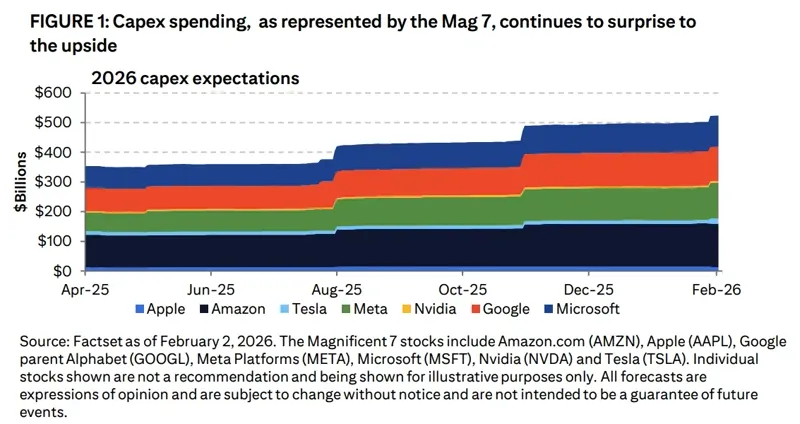
keep reading — 1 min ↗Big Tech companies will have to raise tens of billions of dollars to fund their skyrocketing investments in artificial intelligence this year, as capital spending outpaces cash flows even among some of the world’s most profitable companies. Google’s parent Alphabet, Amazon and Meta all surprised investors with the scale of their AI spending plans over the past two weeks. A total of more than $660bn is set to be ploughed into…
keep reading — 1 min ↗“Be alone, that is the secret of invention; be alone, that is when ideas are born,” said Nikola Tesla in 1934. The inventor spawned his “earthly miracles” not in a busy lab, but in the countless hours spent tinkering away at electrical systems and radio technology on his own. “Originality thrives in seclusion,” he said, “free of outside influences beating upon us to cripple the creative mind.” Philosopher Blaise Pascal made a…
keep reading — 1 min ↗Lastly, the general impression I take away from this budget is the realisation of a party in power which has figured out a way to win elections in India that’s not contingent on strong economic performance. So long as you don’t screw up the economy badly, a combination of emotional issues and timely welfarism (direct cash transfer just before elections is a new, powerful tool now) should see you through most elections.…
keep reading — 2 min ↗A lot of people who think everyone went insane because of social media really don't remember how fundamentally insane people were before social media A lot of otherwise normal teenagers and adults around me
I feel like a kid in a candy store thanks to AI coding tools.
keep reading — 1 min ↗A small corner on the internet to discover wonderful writing.
keep reading — 1 min ↗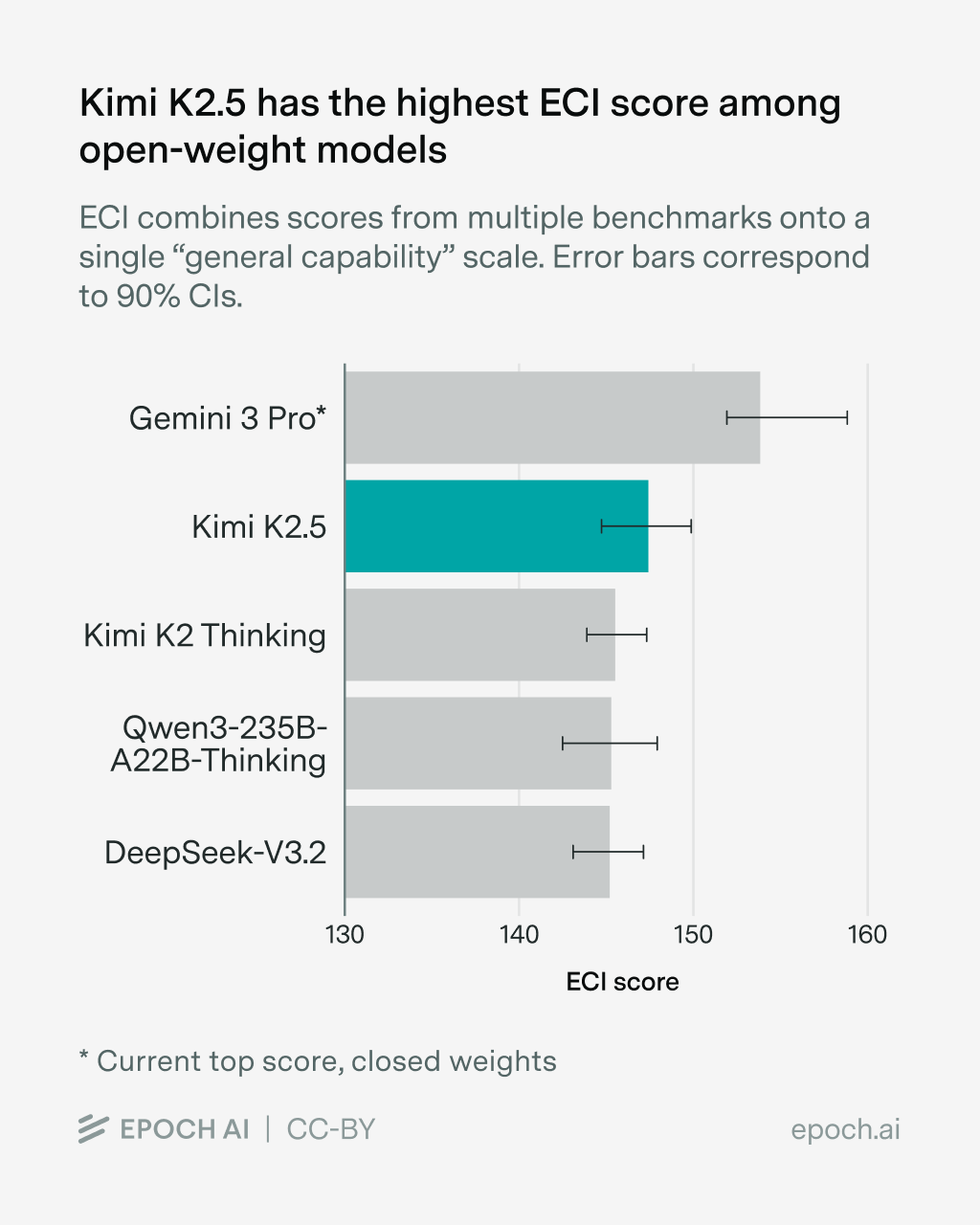
keep reading — 1 min ↗Kimi K2.5 set a new record among open-weight models on the Epoch Capabilities Index (ECI), which combines multiple benchmarks onto a single scale. Its score of 147 is about on par with o3, Grok 4, and Sonnet 4.5. It still lags the overall frontier.
keep reading — 2 min ↗Yet my smartphone has affected my life in often negative ways. The world I disappear to inside it has made me – and probably you – angrier. That’s my main impression of how the world has changed since 2007: we’re all a lot more pissed off with each other. And I really do blame phones. Humans are profoundly social and wired to solve the problems of existence by forming into collaborative groups. When we feel we belong and are…
keep reading — 1 min ↗“I was always a little bored by demonstrations of evil. They relied on the same things. I used to say it always has this top hat and a cape and a tuxedo and a cane. And it has all this stuff. Glamour and costume. Maybe even a little theme music. But goodness never has anything, ‘cause it doesn't want anything. It can't use anything. It's just there.” Toni Morrison (2013) https://youtu.be/Dikga62kLYk?si=xWYzKmpbof-YcmIx
keep reading — 1 min ↗THERE is still time for the cheerful and the gloomy to disagree, sincerely, about the net impact on employment from automation and artificial intelligence. Perhaps AI will unleash a job-creating economic boom for the ages, as boosters maintain. Maybe on balance the doom-mongers are right, and grim legions of algorithm-guided bots and robots will conquer one industry (and profession) after another. One outcome is not up for…
keep reading — 1 min ↗2. Momentum Works Globally The momentum effect appears consistently across international stock markets, with premiums comparable to those in the U.S—there were positive momentum returns in all 31 countries with sufficient data since 1990, with the majority showing statistically significant results. 3. Momentum Is Multi-Dimensional Perhaps the most innovative finding is that momentum extends far beyond simple price trends. The…
keep reading — 1 min ↗"This effectively leads to a situation where smaller company employees are able to be so much more productive than the equivalent at an enterprise. It often used to be that people at small companies really envied the resources & teams that their larger competitors had access to - but increasingly I think the pendulum is swinging the other way. The future I'm starting to get a feel for what the future of work looks like. The…
keep reading — 2 min ↗It’s sort of hard to know how to read a manifesto like this from one of the most powerful figures in tech. Is it a sober, strategic precursor to policy papers for the next administration? The highest-profile episode of AI psychosis yet? A lament about the problems of today written in the technological dialect of tomorrow? If you take out the AI, it reads like a social-democratic electoral platform full of reforms and…
keep reading — 1 min ↗Translation is the act of removing that ladder and replacing it with another ladder, replacing one language with another. In this view, a successful translation can be seen as one that is able to produce the experiences and imagination of the original novel. If this is the aim and consequence of reading, questions of equivalence and felicity are not as significant as it is made out to be by many translators. A good…
keep reading — 2 min ↗I was an untroublesome child who looked after herself. For a short time I went to the village kindergarten, but I didn’t feel too good there. My strongest memory of the place is of being made to have a lie-down in the middle of the day and of sitting in a tree when I didn’t want to play with the other children. But I did have a lot of freedom, which these days would be unimaginable. I used to spend a lot of time at the…
keep reading — 1 min ↗The concerns over social media, and in particular the effects on children, have been well-documented — but Finnish researcher Silja Kosola's recent description of the phenomenon as an "uncontrolled human experiment" has grabbed people's attention once again. Kosola, an associate professor in adolescent medicine, has researched the impact of social media on young people, and tells Yle News that the consequences are not very…
keep reading — 1 min ↗I'm a programmer, and I use automatic programming. The code I generate in this way is mine. My code, my output, my production. I, and you, can be proud. If you are not completely convinced, think to Redis. In Redis there is not much technical novelty, especially at its start it was just a sum of basic data structures and networking code that every competent system programmer could write. So, why it became a very useful piece…
keep reading — 1 min ↗As news publishers try to safeguard their contents from AI companies, the Internet Archive is also getting caught in the crosshairs. The Financial Times, for example, blocks any bot that tries to scrape its paywalled content, including bots from OpenAI, Anthropic, Perplexity, and the Internet Archive. The majority of FT stories are paywalled, according to director of global public policy and platform strategy Matt Rogerson.…
keep reading — 2 min ↗Lots of population numbers are pretty made-up. In many countries, there just isn’t really the infrastructure to do a good census. In Papua New Guinea, they’re not sure if the number of people is 9 million or 17 million. Similar things are true in other countries like Nigeria, which may have tens of millions more or fewer people than is standardly reported. In lots of countries, the way they get their official census numbers…
keep reading — 1 min ↗Goodman writes: Not speaking and speaking are both human ways of being in the world, and there are kinds and grades of each. There is the dumb silence of slumber or apathy; the sober silence that goes with a solemn animal face; the fertile silence of awareness, pasturing the soul, whence emerge new thoughts; the alive silence of alert perception, ready to say, “This… this…”; the musical silence that accompanies absorbed…
keep reading — 1 min ↗Amazon paid Ms. Trump’s production company $40 million for the rights to “Melania,” about $26 million more than the next closest bidder, Disney. The fee includes a related docuseries that is scheduled to air later this year. The budget for “Melania” is unknown, but documentaries that follow a subject for a limited amount of time usually cost less than $5 million to produce. The $35 million for marketing is 10 times what some…
keep reading — 1 min ↗A Ukrainian AI-powered ground combat vehicle near Lyman refused to abandon its forward defensive position and continued engaging enemy forces, despite receiving multiple orders to return to its company in order to preserve its hardware. The UGV reportedly neutralized more than 30 Russian soldiers before it was ultimately destroyed. While the Russian detachment was pinned down, Ukrainian infantry exploited the opportunity and…
keep reading — 1 min ↗All this sounds pretty good for the Montesquieus of the world. But the researchers had another result. Greater market access did seem to weaken family-based co-operation, lowering the share of vulnerable people including orphans, people with disabilities and the elderly being looked after by relatives at home. So if you were looking for a simple answer, sorry. The study supports both sides’ view of markets — they make it…
keep reading — 2 min ↗The lesson to take from Nietzsche is that we all may not fully understand the implications of our most cherished values, our personal beliefs, or actions, and live our entire lives in ignorance or self-denial, unconsciously undermining ourselves and others. How do we avoid this? We need to make sure that the belief systems we occupy, and the values we deeply attach ourselves to, are actually serving us and those around us. We…
keep reading — 2 min ↗With vibe coding, people often report not realizing until hours, weeks, or even months later whether the code produced is any good. They find new bugs or they can’t make simple modifications; the program crashes in unexpected ways. Moreover, the signs of how hard the AI coding agent is working and the quantities of code produced often seem like short-term indicators of productivity. These can trigger the same feelings as the…
keep reading — 1 min ↗AI can ruin your Hinge date. It can detect cosmic anomalies. It can make history come alive. But it cannot suspend the basic laws of economics, says Allison Schrager. Elon Musk’s recent prediction — that AI will make saving for retirement unnecessary — is complete hogwash in her eyes. Consider the following four scenarios. In the future, Allison says AI will either … 1.Make us more productive in the same way that railroads,…
keep reading — 2 min ↗Why think this? First, digital minds could be produced with amazing efficiency. Computing has grown vastly more efficient. If digital minds are possible, it should be cheap to create them in enormous numbers. Second, in the far future, we should expect access to lots of energy. In the next many billions of years, we are likely to find ways of harnessing enormous amounts of energy. Nearly all the stuff in the universe that…
keep reading — 1 min ↗This is not just happening in the automotive industry. In biotech, western pharmaceutical companies are signing billions of dollars in licensing deals to access intellectual property from Chinese drugmakers, reaching $41.5bn in 2024. In robotics, American start-ups are building with Chinese hardware platforms, such as Unitree’s nimble G1 humanoid robot. In AI, Chinese open-source models such as Alibaba’s Qwen series are being…
keep reading — 1 min ↗Knowledge means
keep reading — 1 min ↗Michael Tam, chief brand officer at Shenzhen-based UBTech, which has partnerships with carmaker BYD and Apple contractor Foxconn, said its Walker S2 robots were 30 to 50 per cent as productive as humans and only in certain tasks such as stacking boxes and quality control. Yet manufacturers are still racing to order them to avoid losing out to competitors, Tam told the FT. “You can imagine . . . if Tesla has the advantage of…
keep reading — 2 min ↗There are many things money can buy, but the most valuable of all is freedom. Freedom to do what you want and work for whom you respect. Those who live paycheck to paycheck are slaves. Those who carry debt are slaves with even stouter shackles. Don’t think for the moment their masters don’t know it. Chains I first accumulated the modest amount I needed around 1989. Not enough to retire on perhaps, but enough to say F-you if…
keep reading — 1 min ↗I’ve been in a lot of conversations with people who are seemingly structuring their whole lives around a belief, but when I poke them and ask them simple obvious questions they act like they’ve never thought about it before. This happened a lot in education and pedagogy, a field where notoriously few practices replicate, and a lot of fads take over. I would sometimes meet people who were spending years promoting a specific…
keep reading — 2 min ↗Cummings should know — just four years earlier, he had fought that hardest battle himself: When he was awarded the prestigious Academy of American Poets annual fellowship — the MacArthur of poetry — Cummings had to withstand harsh criticism from traditionalists who besieged him with hate for the bravery of breaking with tradition and being nobody-but-himself in his art. With an eye to that unassailable creative integrity…
keep reading — 1 min ↗a huge part of success is simply not becoming blackpilled for as long as humanly possible. i know so many guys that could have achieved great things but get lost because they confused cynicism for wisdom. you must not get blackpilled, do well, and we'll all be saved at the end.
keep reading — 1 min ↗Every engineer needs to learn how to design systems. Every researcher needs to learn how to run a lab. Agents push the humans up the org chart. I feel like I have an advantage by being early to this wave, but no longer feel like just working hard will be an lasting edge. When I can have multiple agents working productively in parallel on my projects, my role is shifting more to pointing the army rather than using the…
keep reading — 2 min ↗I feel torn about whether the RLHF generation should count as ‘just predicting the next word,’ but the latest generation is a very clear “no” for me. This generation is even more different: The AI is presented during training with hard problems, and it thrashes around until it has learned a general skill of problem-solving. I know this sounds pretty wild, but it works; this is the technique11 that lets the AI outperform the…
A great guide on how to use AI agents to build good software. Although this is for developers, there are plenty of takeaways of normies as well.
keep reading — 1 min ↗keep reading — 2 min ↗Just why the liberal world has found itself in crisis is a matter of active debate. There are voices on the right arguing that liberalism was never a particularly good idea in the first place: that people need to be ruled, or that true fulfillment only comes through celebration of god and tribe and tradition. As someone who very much enjoys thinking for himself and making his own choices I find these arguments unappealing at…
keep reading — 1 min ↗This is perhaps tangential, but I think the "books can't teach you anything" argument comes from the accurate observation that most modern novels honestly can't teach you anything. Classic literature was consumed with the struggle between good and evil; it obsessed over the question of humanity and its greater purpose; it scrutinized what it means to find true happiness. It was philosophy wrapped in the glory of a very human…
keep reading — 1 min ↗the things that drive humans have been remarkably consistent across time, across technological progress, and across societies. no matter what kind of millenarianism you are indulging in (ai, ufos, etc)-- you can bet the forces of pride, greed, lust, gluttony, etc are constant
Useful video on how to use Obsidian with Gemini
keep reading — 1 min ↗keep reading — 1 min ↗But over the past several years the field of neuroscience seems to have moved away from this modular approach (each brain region has its own job). Researchers are more likely to believe that the brain is a network of interconnected regions. They are more likely to talk about vast and dynamic webs of neurons whose connections link disparate parts of the brain. Luiz Pessoa, who runs the Maryland Neuroimaging Center, recently…
keep reading — 2 min ↗This pattern of “hype first and context later” is actually part of a growing trend. I call the individuals participating to that trend “The Influentists”. Those people are members of a scientific or technical community, and leverage their large audiences to propagate claims that are, at best, unproven and, at worst, intentionally misleading. But how can we spot them? I personally identify these “Influentists” by four…
keep reading — 1 min ↗The reason could be that when you are powerful, people take note only when that power falters. The world was hardly impressed when Trump went on his tariff rampage; what struck people was when China successfully fought back. America demonstrated stunning military power in Venezuela but it was also expected; what people have noticed is Russia’s military failure in Ukraine. People also notice who envies whom. And it is no…
keep reading — 3 min ↗Summary by Claude. Let me break down what Jones and Tonetti are arguing. The Core Question How much of past economic growth came from automation, and what does that tell us about AI's future impact? The Key Insight: "Weak Links" The paper's central concept is that economic production involves complementary tasks — you need all of them to produce output. Think of it like a chain: your output is limited by your weakest link,…
keep reading — 1 min ↗Since Claude can’t create the good abstractions. Claude’s powers are limited by how good the blocks you give it are. Have no illusions; Claude cannot reproduce Sentry and Terraform and Playwright. These are incredibly complex and well-designed pieces of code. And since Claude can’t create good abstractions on its own, there’s a limit to how much anyone can do with Claude alone. Even though everyone on X thinks you can…
keep reading — 1 min ↗I was interpreting an odd statutory investment limitation today and got stuck (no guidance anywhere). Asked GPT-5.2 Pro to find examples of companies that have ever exceeded this investment limitation (which would disprove the contrary interpretation). GPT-5.2 Pro proceeded to trawl the internet for random places where financial statements of these regulated entities are available (there is no central database). Analyzed a…
keep reading — 2 min ↗My guess: the virtual coworker coming next year is going to be something like a nice UI sitting on top of an agent operating your computer using mostly a command line, occasionally GUI use, with obscure bash commands translated to natural language by a tiny intermediary LLM. The agent will be able to designate subagents, probably, to do specific things behind the scenes. It'll be able to access many of the software and cloud…
keep reading — 2 min ↗The new leverage comes from moving one layer up. Instead of doing every task ourselves, we design systems that can do them for us. A single agent can now execute autonomously what used to require long hours my time, freeing my attention for higher-level decisions, design, judgment. And maybe just... enjoying the life with my loved ones? This all immensely increases the leverage of single engineer. Technically, you're one well…
I've been heavily using voice typing to write a lot of posts and it's been fun. This mode of writing helps me unlock a newer and more expressive voice. To be clear, I don't think this style of writing is a replacement for the regular style of writing but it's a different kind of writing. I came across these free and…
keep reading — 1 min ↗keep reading — 1 min ↗Manipur’s misfortunes can seem irrelevant to Indians who live in the country’s heartlands. Yet the state’s fate has national implications. It has been riven by a decades-long insurgency, led largely by Meitei groups who desire independence. That had been quelled in recent years, but as frustration and alienation deepen there is a risk that it will resurface. Above all, the crisis offers a warning about the dangers of identity…
keep reading — 2 min ↗Anything that can be automated should be. There’s no good reason humans should be making excel models or powerpoints in 10 years, any more than they should be hand-washing clothes. It’s toil and drudgery. What will remain? Anything we want to do because it’s fun or interesting. May be weird but I view automation as a moral imperative so that everybody can spend their time gardening or making art or playing chess or making…
keep reading — 4 min ↗I totally see the value in the feature and I would like to find a way to add it. But the reality is that 75% of the people on our engineering team lost their jobs here yesterday because of the brutal impact AI has had on our business. And every second I spend trying to do fun free things for the community like this is a second I'm not spending trying to turn the business around and make sure the people who are still here are…
keep reading — 1 min ↗If you’re thinking about starting an argument with “AI will eventually automate all jobs,” I’m begging you to (1) talk to a plumber and a kindergarten teacher, and (2) have an economist walk you through how a big increase in the efficiency of producing X impacts demand for not-X. “Not only do most jobs involve doing work in the physical world (plumbers), many jobs involve forming emotional relationships with other human…
keep reading — 2 min ↗In fact, I have great optimism that one potential upside of AI is a renewed appreciation of and investment in beauty. One of the great tragedies of the industrial era — particularly today — is that beauty in our built environment is nowhere to be found. How is it that we built intricate cathedrals hundreds of years ago, and forgettable cookie-cutter crap today? That is, in fact, another labor story: before the industrial…
keep reading — 1 min ↗I have come to see that writing has become a way for me to be in the deepest conversation with myself while also sensing the hovering presence of another. I don’t know who that other is – perhaps a gentle future reader. This personal conversation feels forbidden, in a way, given my work in journalism. But I find treasures in my thoughts and feelings, and I rush to put them on the page. Then a story takes shape and tells me…
keep reading — 1 min ↗For those of us interested in reality, the question becomes: Might there be some downsides of kidnapping the president of a sovereign nation, because he is not sufficiently in America’s pocket? One thing we have done is to supercharge the urgency of almost all smaller nations on earth to unite with one another to protect themselves against our aggression, and to seek out competing superpowers—China, most obviously—to align…
keep reading — 1 min ↗Most human beings are elementally similar but structurally different. Every living being around us is elementally similar, most are roughly the same few elements, but the arrangements of those carbons, protons, neutrons, electrons are different. That arrangement is what makes you you. That is the unique pattern for every species on Earth, and even for every individual. Seven billion humans, billions of animals, other species,…
keep reading — 1 min ↗Future historians will see that the seeds of a profound transformation were planted in 2025. By 2050, most people will command workforces larger than the biggest multinational corporations of today. But our “employees” won’t be people sitting in cubicles or standing on factory floors. They will be fleets of AI agents—digital workers which can perform tasks like design products, write code, negotiate supply chains, run complex…
keep reading — 1 min ↗I’m not trying to push you in any direction, honest. If you get everything totally wrong, too bad, but you’ll still be remembered forever for trying. Even Pontius Pilate has immortality of a sort. Both Eliezer Yudkowsky and Beff Jezos have their page in the textbooks assured. If you’re a well-off Silicon Valley person, you’re already well-placed to join them. So participate in the discourse. Create some art. Donate to a cause…
As a normal, non-technical person, I think we are living in magical times—and I say this because of LLMs, especially the LLM coding tools. As someone who doesn’t know a lick of programming, the fact that a person with absolutely no idea what coding is can still wrangle these tools and get useful things built is the…
keep reading — 2 min ↗keep reading — 1 min ↗OpenAI in particular should beware hubris. One vc says discussion of cash burn is taboo at the firm, even though leaked figures suggest it will incinerate more than $115bn by 2030. Sam Altman, its boss, said recently that one reason he wants to take OpenAI public is to watch its doubters sell it short. “I would love to see them get burned on that,” he said. Plenty of investors seem prepared to take the bet: both the public…
keep reading — 1 min ↗Our appetite for AI slop is likely to be similarly insatiable. The adoption curve we’ve seen so far may pale beside what happens when disposable software production becomes truly mainstream. If the democratisation of software mirrors the impact of ubiquitous photo, video, and audio capture enabled by the smartphone, we may see user-generated software created, shared, and discarded at social-media scale. Should that happen,…
keep reading — 1 min ↗What I didn’t realize was that writing a Substack would also reignite my intellect. Over the first five months, I posted an essay nearly every week. I’ve always read a lot, but before, the words passed through me—my mind a sieve. Now, I keep dozens of running files in my notes app about topics I hope to write about. Before, spare moments were taken up by mindless scrolling. Now, they’re spent writing and editing. Substack…
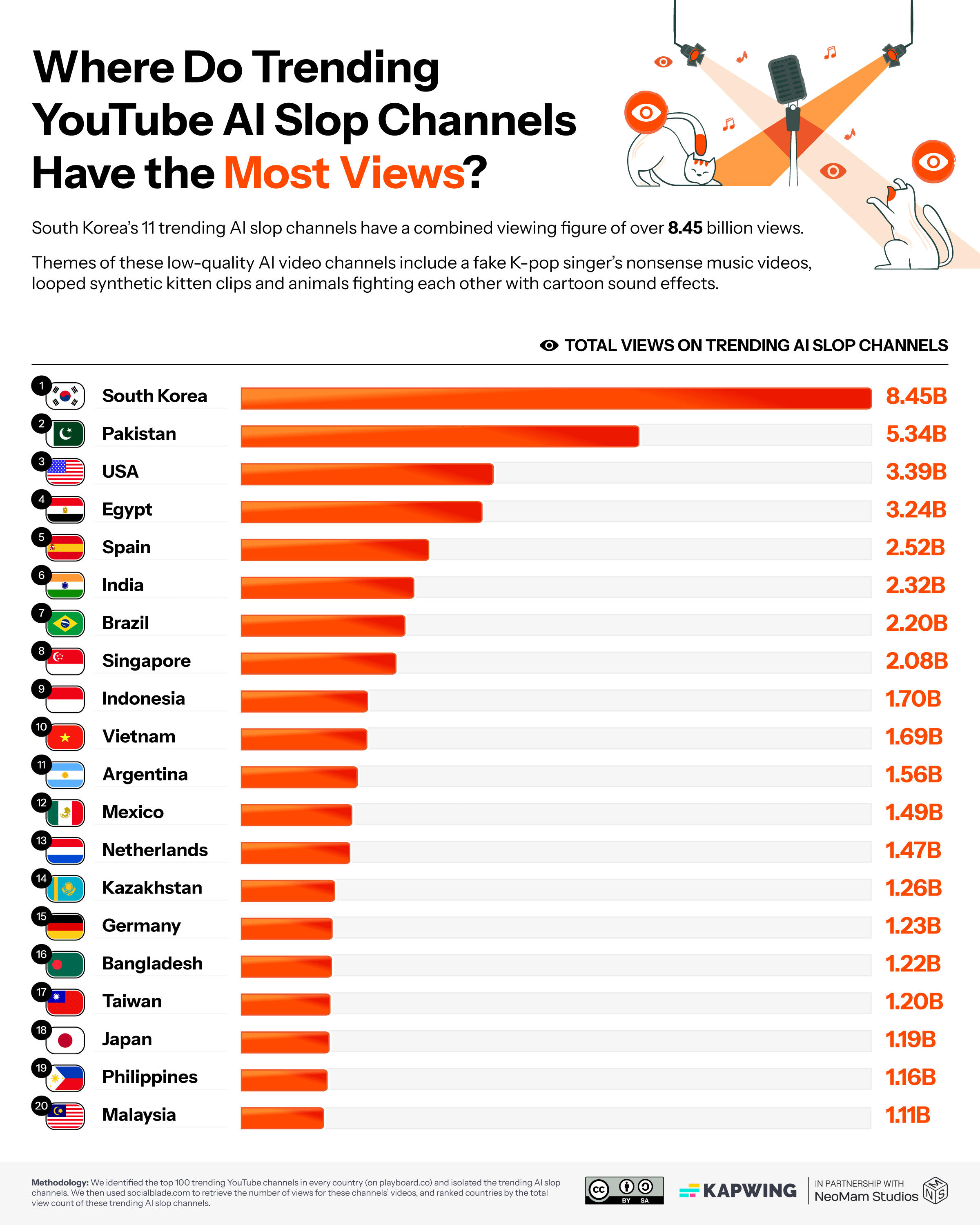
keep reading — 1 min ↗Five of the other ten trending AI slop channels with the most views are based in South Korea, with others in Egypt, Brazil and Pakistan. But the channel with the most views of all is in India. Bandar Apna Dost features over 500 videos, mainly “featuring a realistic monkey in hilarious, dramatic, and heart-touching human-style situations,” Many of which are variations on identical set-ups. The channel also has around 100,000…
keep reading — 2 min ↗It’s incredible how far “vibe coding” has come this year. Whereas in May I was amazed that some prompts produced code that worked out of the box, this is now my expectation. I can ship code now at a speed that seems unreal. I burned a lot of tokens since then. Time for an update. It’s funny how these agents work. There’s been this argument a few weeks ago that one needs to write code in order to feel bad architecture and that…
keep reading — 4 min ↗The believers in miracles accept them (rightly or wrongly) because they have evidence for them. The disbelievers in miracles deny them (rightly or wrongly) because they have a doctrine against them. G.K. Chesterton
keep reading — 1 min ↗The core finding: even under generous assumptions about hardware efficiency and utilization, we are likely 8–50x short on compute for consumer inference alone in a mature agentic and multimodal world. This is before accounting for enterprise, sovereign, robotics, or training demand. Three claims underpin this framework: 1\. Tokens are the kWh of knowledge work. As price falls, users don't ask the same questions more cheaply;…
keep reading — 1 min ↗But the debt sales, tracked by trade body Sifma through to the end of November, also reflect an AI borrowing boom, as Big Tech groups including Meta, Alphabet, Amazon and Oracle tapped bond markets to fund data centres and the energy systems needed to power them. AI-related borrowing now accounts for about 30 per cent of net investment-grade issuance, according to Goldman Sachs, and is expected to grow in 2026, despite…
keep reading — 5 min ↗This blog post by Tim Dettmers argues that the popular idea of \\Artificial General Intelligence (AGI)\\—an AI that can do anything a human can—and \\"superintelligence"\\—AI that becomes infinitely smarter than humans—are \\unrealistic fantasies\\ \[1, 2\]. He believes these concepts ignore the harsh realities of the physical world \[2, 3\]. Here is a breakdown of the key concepts to help you understand his argument: \### 1.…
keep reading — 1 min ↗2025 is where I (and I think the rest of the industry also) first started to internalize the "shape" of LLM intelligence in a more intuitive sense. We're not "evolving/growing animals", we are "summoning ghosts". Everything about the LLM stack is different (neural architecture, training data, training algorithms, and especially optimization pressure) so it should be no surprise that we are getting very different entities in…
keep reading — 2 min ↗As an adult now living in the city, I often find myself wondering, where do kids go for that kind of independent play today? This is exactly what evolutionary anthropologist Eli Stark-Elster explores in a recent essay. We like to blame tech companies for trapping our kids in digital spaces – and sure, the slot-machine mechanics are real. But Stark-Elster argues we’re missing the bigger picture: “Digital space is the only…
keep reading — 2 min ↗To get a sense of the immense progress on predictive AI and its future potential, we can look at the trajectory of the past 20 years. In 2005, we couldn’t get AI to tell the difference between a person and a pencil. By 2013, AI still couldn’t reliably detect a bird in a photo, and the difference between a pedestrian and a Coke bottle was massively confounding (this is how I learned that bottles do kind of look like people, if…
keep reading — 4 min ↗I agree with all this; it is why I also believe that opus 4.5 in claude code is basically AGI. Most people barely noticed, but \it is happening.\ It’s just happening, at first, in a conceptually weird way: Anyone can now, with quite high reliability and reasonable assurances of quality, cause bespoke software engineering to occur. This is a strange concept. Most people, going about their day, do not think about how "causing…
keep reading — 2 min ↗So much held in a heart in a lifetime. So much held in a heart in a day, an hour, a moment. We are utterly open with no one in the end—not mother and father, not wife or husband, not lover, not child, not friend. We open windows to each but we live alone in the house of the heart. Perhaps we must. Perhaps we could not bear to be so naked, for fear of a constantly harrowed heart. When young we think there will come one person…
keep reading — 1 min ↗Turns out it was almost all built by LLMs At this point I went looking for some more background information on the library and found Emil’s blog entry about it: How I wrote JustHTML using coding agents: Writing a full HTML5 parser is not a short one-shot problem. I have been working on this project for a couple of months on off-hours. Tooling: I used plain VS Code with Github Copilot in Agent mode. I enabled automatic…
keep reading — 2 min ↗The grave dangers AI safety hawks worry about can’t be adequately addressed without extensiveo international cooperation—cooperation tight enough to qualify as international governance. If, for example, your nation regulates AI skillfully enough to keep a bioweapon from being built on your soil, that won’t save you from the global pandemic that originates in a laxer nation; international regulation is needed. If you’re…
A few links I've saved for later. \- \Gans and Doctorow on AI Copyright\ \- \Variation in Working Hours Across Countries and Over Time\ \- \The 26 Most Important Ideas for 2026\ \- \The Japanese Canary in the Global Debt Coal Mine\ \- \Agentic Interactions\ \- \The Future Is Flesh-and-Blood\ \- \Horses\ \- \Quantum…
keep reading — 1 min ↗I heard that the lecture was depressing. Yet to watch it. https://www.youtube.com/live/7QMHh3kMG74?si=On43DLvZKNDSXTWh https://www.nobelprize.org/prizes/literature/2025/krasznahorkai/lecture/
keep reading — 1 min ↗Kyla Scanlon is one of the most perceptive writers about the US economy and culture. Several years ago, she coined the term "vibecession" to describe the divergence between economic data and how people felt. In other words, after the pandemic, something weird started happening in the US. While economic data, despite…
keep reading — 1 min ↗A few good rabbit holes: 1\. The illusion of knowledge 2\. AI capex boom 3\. China and weaponized interdependence
keep reading — 1 min ↗
keep reading — 2 min ↗There can be only one permanent revolution—a moral one; the regeneration of the inner man. How is this revolution to take place? Nobody knows how it will take place in humanity, but every man feels it clearly in himself. And yet in our world everybody thinks of changing humanity, and nobody thinks of changing himself.
keep reading — 3 min ↗Agents are here. They can do real work, and while that work is still limited, it is valuable and increasing. But the same technology that can replicate academic papers in minutes can also generate 17 versions of a PowerPoint deck that nobody needs. The difference between these futures isn’t in the AI, it’s in how we choose to use it. By using our judgement in deciding what’s worth doing, not just what can be done, we can…
A few links for your consideration.
keep reading — 1 min ↗keep reading — 5 min ↗Today China’s share of global export containers is over 36%, though the country represents around a fifth of world GDP. A foreign-business boss in China foresees a reckoning: “There will come a point in time when China and the world simply cannot absorb more Chinese goods, and I think that point is approaching.” China’s overall trade surplus is on track to exceed $1 trillion this year, with record-setting shipments to Africa,…

keep reading — 3 min ↗Another cause for optimism is that healthy human lifespans keep stretching, allowing people to stay productive for longer. In a 41-country sample, a 70-year-old in 2022 had the same cognitive abilities as a 53-year-old had in 2000. Perhaps such progress will end. But as long as it continues, it will slow the shrinkage of labour forces, giving societies crucial extra decades to adapt. Countries that waste human capital may…
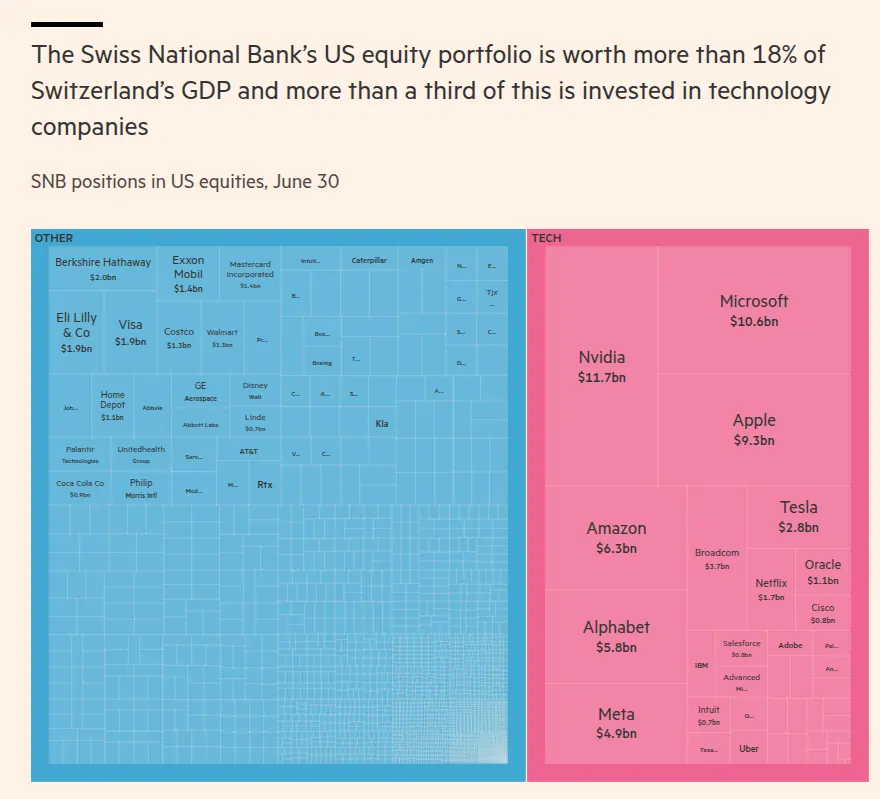
keep reading — 2 min ↗The Swiss National Bank has US equity holdings amounting to $167bn, spread across more than 2,300 positions, according to SEC filings from June.
keep reading — 2 min ↗Hadot isn’t saying philosophy-as-life disappeared after antiquity and medieval times, leaving only professors in universities. He notes that the existentialists, for instance, carried this tradition forward. Other scholars—like Matthew Sharpe and Michael Ure—have shown that it runs through Socrates, the Stoics, medieval and early modern thinkers, Descartes, Bacon, Schopenhauer, Nietzsche, and even Foucault. My own…
keep reading — 4 min ↗Bukele has forced Salvadorans to trade civil liberties for a sense of security, a bargain that has only grown starker over his five years as president. But whether this arrangement lasts depends on whether it can evolve into a sustainable model of governance, which, given current economic stagnation and mounting social pressures, appears increasingly unlikely without escalating repression. El Salvador could proceed down a few…
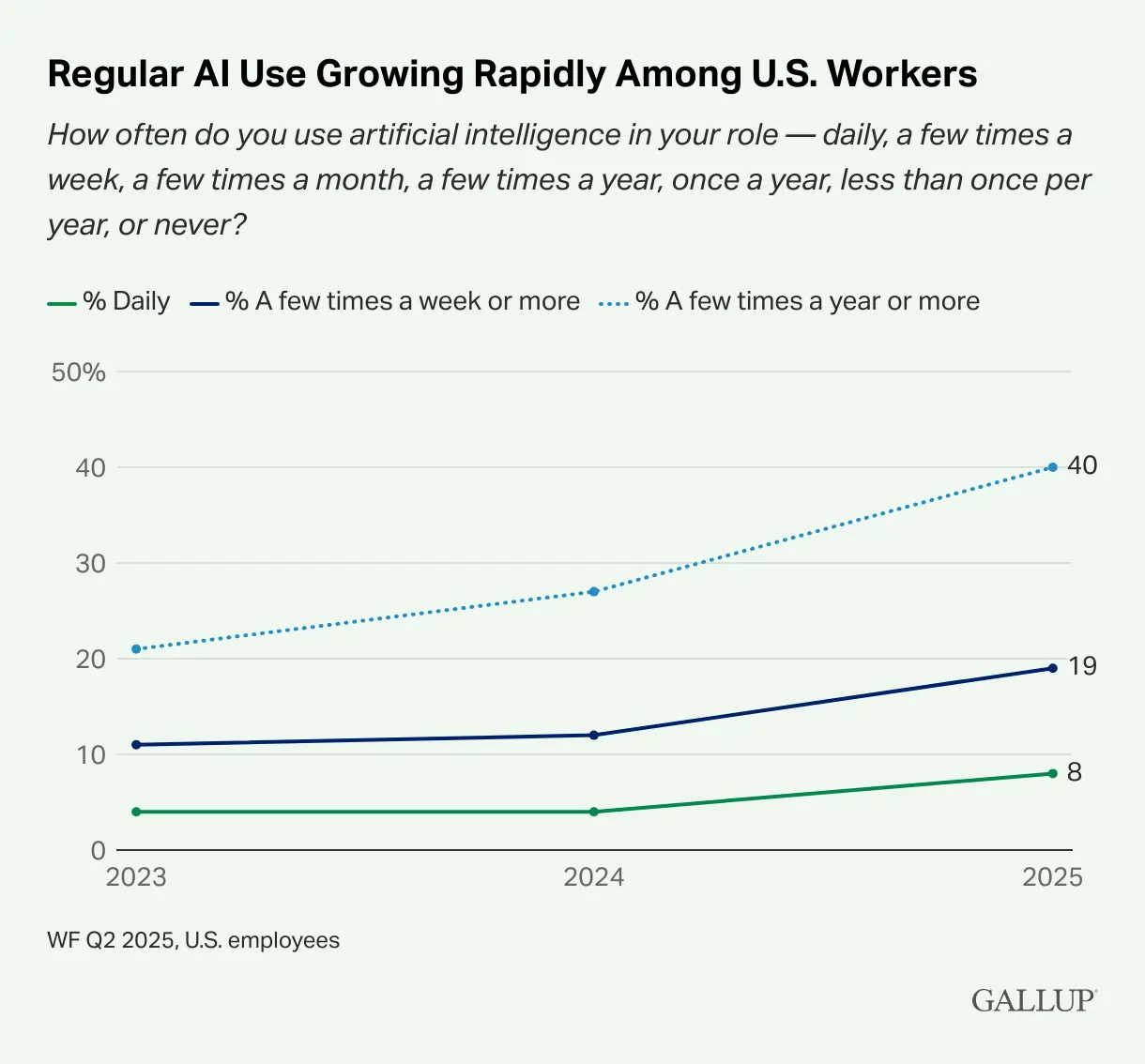
keep reading — 10 min ↗The policy, which takes effect immediately, will potentially apply to Chinese companies from ByteDance and Tencent to Alibaba. “We are taking action to close a loophole that allows Chinese companies to access frontier AI,” said the executive, who added that the policy would also apply to US adversaries including Russia, Iran and North Korea. The executive said the policy was designed “to align with our broader commitment that…
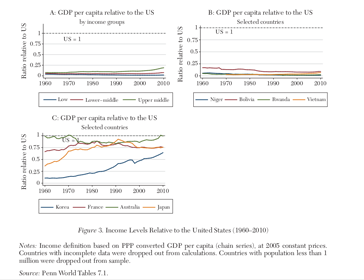
keep reading — 5 min ↗What Remains of Cross-Country Convergence? A Critical Review of 50 Years of Economic Growth Research. Summary by Claude. This comprehensive 2020 review by Paul Johnson and Chris Papageorgiou examines one of economics' most enduring questions: Do poor countries eventually catch up to rich ones? After analyzing five decades of research and data, their conclusions challenge popular narratives about global economic convergence.…
A collection of the most insightful articles on culture, philosophy, history, science, finance, economics and much more.
keep reading — 1 min ↗keep reading — 4 min ↗It’s of course unclear what the future holds, but there’s a growing sense that the AI phenomenon is more bubble than boom. As such, rather than viewing the enterprise AI frenzy on Silicon Valley’s terms, as an inevitable jobs apocalypse, we have an opportunity to view it on material terms, and examine how it’s actually playing out on the ground. On those terms, we see managers, executives, and corporations using rebranded…
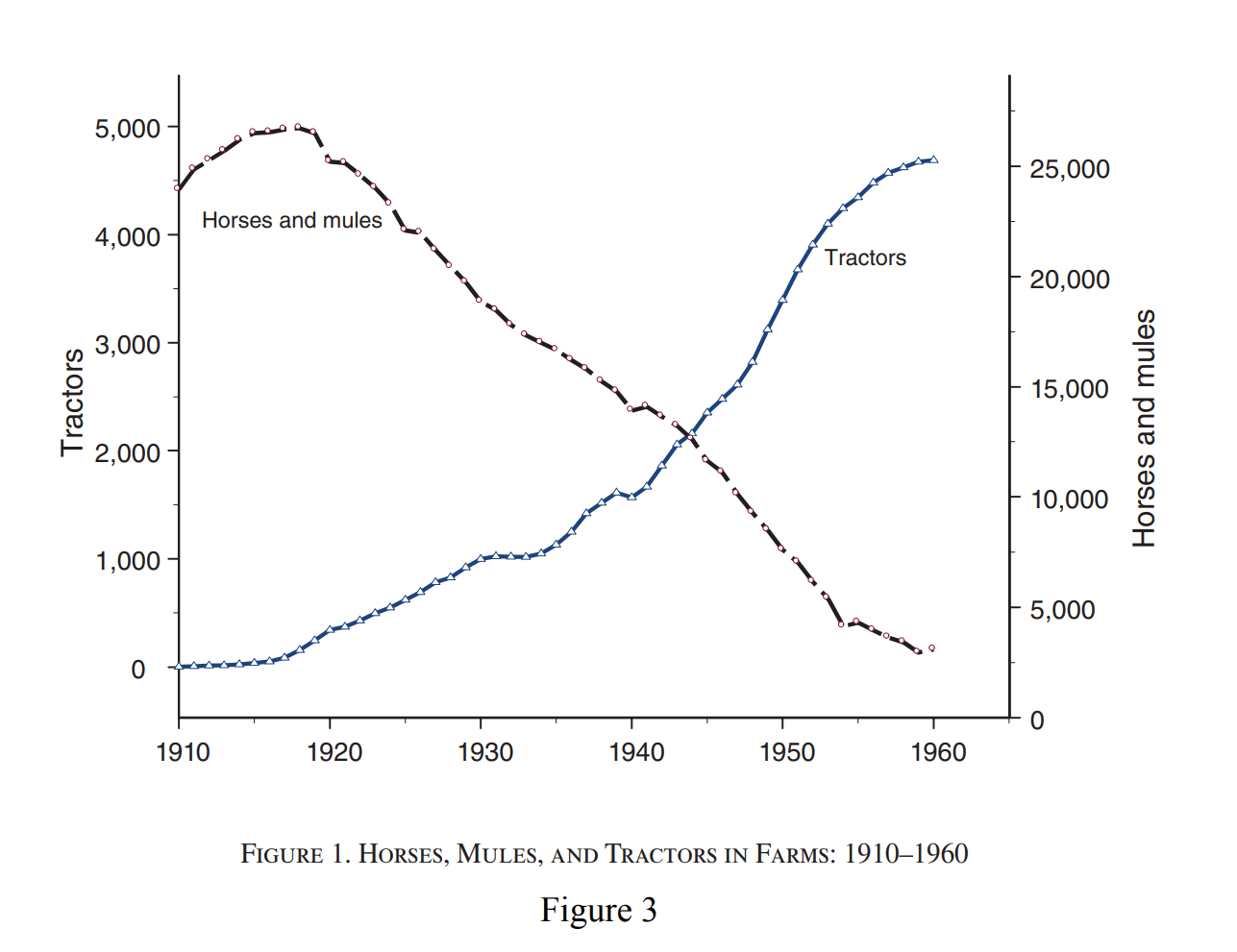
keep reading — 7 min ↗Will this change as models become more capable? Perhaps?? But I think it’s going to require a change in how models are built and optimized. Software engineering requires models that can do more than just generate code. When a person runs into a problem, they are able to temporarily stash the full context, focus on resolving the issue, and then pop their mental stack to get back to the problem in hand. They are also able to…

keep reading — 3 min ↗Knapp and her colleagues have found in a new study, appears to be the case for the world’s third-most important staple crop: The 8-to-9-million-year-old lineage that begat the modern potato may have arisen from a chance encounter between a flowering plant from a group called Etuberosum and … an ancient tomato. Tomatoes, in other words, can now justifiably be described as the mother of potatoes. The plant experts I interviewed…
keep reading — 29 min ↗Humans are quite plastic; our sensory apparatus changes based on the communication environment in which we are raised. But we're not infinitely plastic. The information-density frontier must involve all of our senses, telling us something about what the human is, what evolution has designed us for. When are our senses most heightened? When the stakes are high and we are physically engaged with many other people. Team sports.…